Germany Sends Eurofighters to Latvia as NATO Air Security Focus Intensifies
Four German Eurofighter jets will support NATO air-defense operations in Latvia during parliamentary elections scheduled for October 3.
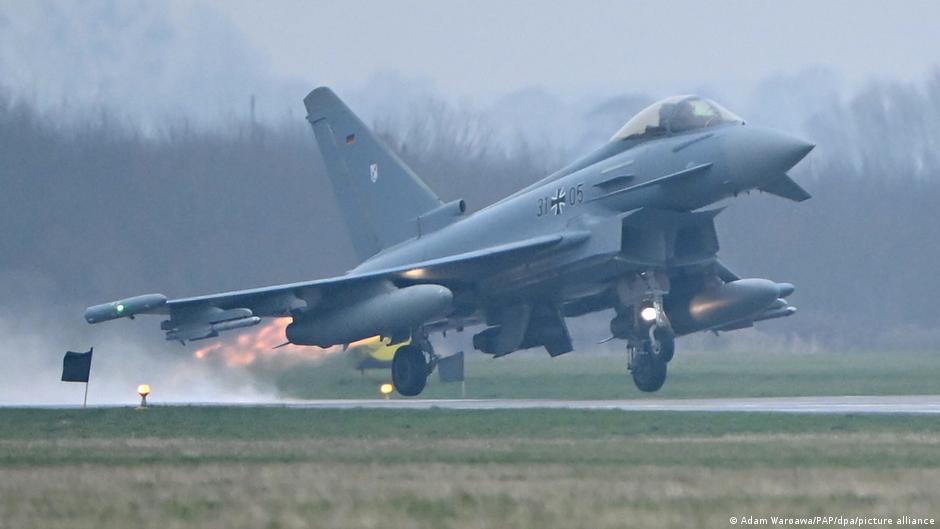
Germany has deployed four Eurofighter jets to Latvia for a short-term NATO air-security mission around the country’s parliamentary elections, adding a fresh geopolitical signal for markets tracking defense readiness, Baltic security risk and European military positioning on NATO’s northeastern flank.
The aircraft, drawn from the Bundeswehr’s 74th Tactical Air Wing at Neuburg an der Donau air base, were transferred to the Lielvarde military airfield in central Latvia. Latvia’s defense ministry in Riga said on Thursday, September 24, that the deployment is intended to help secure Latvian airspace during the October 3 parliamentary vote.
The Eurofighters are expected to remain in Latvia for slightly more than a week. During that period, they will carry out tasks supporting NATO’s integrated air and missile defense system, according to the information released by Latvian authorities.
For market participants, the move adds to the steady stream of defense and security developments shaping sentiment around Europe’s eastern frontier. While the deployment is limited in duration and framed as election-period support, it comes against a broader backdrop of repeated airspace violations affecting the Baltic states and continued pressure on European governments to demonstrate rapid-response capability.
Security Deployment Adds to Baltic Risk Watch
Riga had asked NATO allies for support following repeated violations of Baltic airspace, the dpa news agency noted. That request reflects the continuing sensitivity of the region more than two years after Russia’s full-scale war against Ukraine began reshaping Europe’s security architecture, defense budgets and procurement priorities.
Latvian Prime Minister Andris Kulbergs thanked Germany on X for its “readiness to help and close cooperation.” He described the deployment as a practical demonstration of allied backing.
“This is a concrete sign of NATO solidarity and our shared commitment to protecting Latvia’s airspace and the security of Latvia’s population,” Kulbergs said.
NATO has maintained air-policing coverage over the northeastern flank of the alliance since Estonia, Latvia and Lithuania joined in 2004. The mission has become more prominent since the start of Russia’s full-scale invasion of Ukraine, after which drones repeatedly entered the airspace of the Baltic states.
In August, NATO fighter jets shot down a drone that had violated Latvian airspace. That incident, along with other incursions, has kept Baltic air security on the policy agenda and sustained investor attention on European defense stocks, regional infrastructure risk and the fiscal implications of higher military readiness.
The current German deployment does not represent a permanent basing decision in Latvia. It is a temporary measure linked to the election period and to NATO’s integrated air-defense posture. Still, it highlights the operational tempo required to police airspace in a region where military, political and market risks increasingly overlap.
Defense Sector Context for Traders
The transfer of German aircraft to Latvia lands in a market environment where defense-sector news can quickly affect trading narratives, even when individual announcements do not include procurement contracts or new spending figures. Investors have been closely watching signals from NATO governments on air defense, missile defense, drones and rapid-deployment aviation assets.
No trading volumes, share-price moves or contract values were included in the Latvian announcement. The immediate market significance is therefore not a direct revenue event, but a geopolitical and sector-intelligence marker: NATO members continue to reposition high-value air assets in response to Baltic security concerns, and European governments remain focused on the alliance’s eastern and northeastern perimeter.
Germany’s Eurofighter fleet is also set to play a longer NATO role from December 2026, when the aircraft are due to resume extended airspace monitoring from Estonia under the NATO Air Policing mission. Through March 2027, five Eurofighter jets, along with flight crews, are expected to be stationed at Amari air base in northwestern Estonia.
That future deployment suggests continuity in NATO’s air-policing requirements and keeps attention on the operational demands facing European air forces. For investors following aerospace and defense, such missions can feed into longer-term assessments of fleet utilization, maintenance needs, readiness spending and demand for integrated air and missile defense systems.
The Latvia deployment is also politically timed. Parliamentary elections are scheduled for October 3, and the presence of allied aircraft is intended to strengthen protection of national airspace during the vote. In market terms, the episode underlines how electoral calendars, border security and military coordination can converge in frontier-risk monitoring.
Latvia’s appeal for allied support, Germany’s response and NATO’s continuing air-policing role all point to a security environment in which short-notice deployments are becoming part of the baseline operating picture. For traders and analysts, the development is another data point in the wider rotation of attention toward European defense capability, Baltic exposure and the strategic assets needed to enforce NATO airspace.