German Military Refusal Filings Surge as Bundeswehr Recruitment Accelerates
Germany recorded at least 12,102 military-service refusal declarations in the first eight months of 2026, more than triple the 2025 total.
Germany’s defense labor market is showing a sharp split in real time: applications to avoid military service are rising quickly, even as the Bundeswehr reports stronger recruitment flows and the highest troop count in 13 years.
From January through the end of August 2026, at least 12,102 people in Germany declared that they did not wish to serve in the country’s armed forces. The declarations were submitted to the Federal Office for Family and Civil Society Affairs, or BAFzA, according to reporting by the Funke media group on Monday, October 5.
The move marks a notable escalation in the personnel debate around Germany’s armed forces. In all of 2025, German authorities received 3,879 applications from people refusing military service. That means the number of refusal declarations in only the first eight months of 2026 was more than three times the full-year 2025 figure.
For market participants tracking European defense exposure, the figures add another data point to a sector already being shaped by higher security concerns, expanding procurement plans and renewed debate over force readiness. The immediate signal is not a simple negative for military staffing: refusal filings are rising, but so are applications, assessments and active personnel numbers under the new recruitment system.
Recruitment Reform Drives New Volumes
Part of the increase in refusal declarations is linked to the rollout of questionnaires from Germany’s Defense Ministry. A law reforming recruitment into the Bundeswehr took effect on January 1. Under the system, beginning in 2026, 18-year-old men are required to fill out a questionnaire asking whether they are willing to join Germany’s armed forces.
Young people are entitled to declare in advance that they refuse military service. That procedural change appears to have created a new channel for early declarations, increasing the volume of filings visible to the authorities.
BAFzA said refusal applicants often make mistakes in their submissions, with some filings failing to meet the requirements for recognition as a justified refusal.
A BAFzA representative said applicants frequently make errors when filling out their refusal declarations. The content of some submissions “does not meet the requirements for recognizing the refusal as justified,” meaning those applications “have to be returned without consideration,” the official was quoted as saying.
The broader context is a tense security environment and Germany’s debate over whether compulsory service, suspended in 2011, could return in a partial form. A so-called “military obligation if needed” could be introduced by a decision of the Bundestag if Germany fails to reach the required number of volunteers.
Defense Ministry planning calls for up to 260,000 people to be serving in the Bundeswehr at the same time by 2035. That target has become a key benchmark in assessing whether Germany’s current voluntary recruitment model can scale sufficiently without a stronger compulsory element.
Troop Count and Applications Also Rise
The rise in refusal filings is occurring alongside positive recruitment indicators from the Defense Ministry. At the end of July 2026, the ministry reported that the Bundeswehr had reached its highest number of military personnel in 13 years, at 186,700 service members.
Compared with July 2025, that represented an increase of more than 2%, or 3,700 personnel. The ministry also said that out of about 378,000 people who had received questionnaires since the start of 2026, around 2,630 went through the service-fitness assessment process in July alone. That was 35% more than in the previous month.
By that point, around 12,100 volunteers and short-term contract soldiers were already serving in the Bundeswehr under the new recruitment system. That was approximately 6% higher than a year earlier.
The ministry also recorded a significant increase in applications and admissions for contract military service. In July 2026, 47,300 people submitted relevant applications, up 26% from the same month in the prior year. As of the end of July, the number of new recruits stood at 15,400, a 12% increase compared with 2025.
For investors following defense contractors, staffing levels matter because they influence the pace at which procurement, training, logistics and operational readiness programs translate into actual demand. Rising recruitment activity may support expectations for a larger personnel base, while elevated refusal declarations point to social and political friction around any deeper mobilization model.
Public Resistance Remains a Policy Risk
The Bundeswehr has broadened its search for new recruits in recent years, including by setting up a stand at Gamescom, one of the world’s largest video game exhibitions, held in Cologne. The move reflects a wider push to reach younger audiences and expand the recruitment funnel beyond traditional channels.
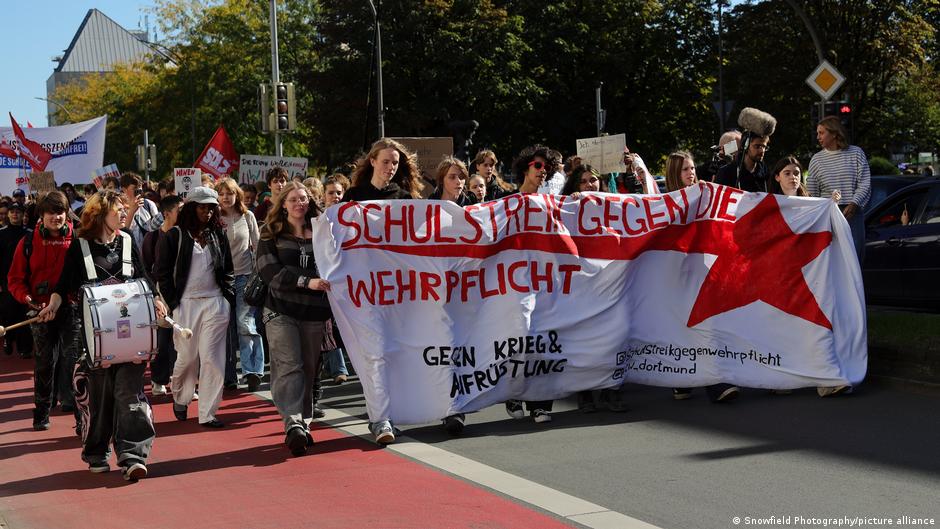
At the same time, German school students have criticized the possible return of a “military obligation if needed.” In September, large protests related to the issue took place in several German cities, highlighting the political sensitivity of any shift toward compulsory service.
The data therefore point to a two-sided market event in Germany’s defense personnel pipeline. On one side, the state is seeing higher recruitment activity, more applications for contract service, more fitness assessments and a growing number of active service members. On the other, a much larger number of people are formally signaling an unwillingness to serve, with refusal declarations already far above last year’s total.
That tension is likely to remain central to Germany’s defense planning as the country works toward its 2035 personnel objective. For markets, the immediate read-through is that defense-sector momentum is not only a procurement story. It is also a labor-capacity story, shaped by policy design, public consent and the ability of the Bundeswehr to convert questionnaire outreach into sustained service numbers.