Bosnia Vote Delivers Status Quo as Dodik Allies Hold Key Serb Posts
Preliminary results showed ruling-party candidates ahead across Bosnia and Herzegovina, preserving the political balance watched by regional markets.
Preliminary election results in Bosnia and Herzegovina pointed to a broad victory for candidates backed by governing parties, leaving the country’s complex political structure largely unchanged and giving investors little immediate sign of a shift in regional risk.
The vote covered the members of Bosnia and Herzegovina’s tripartite presidency, the central parliament, two regional parliaments and the presidency of Republika Srpska, the Serb-majority entity within the country. According to preliminary results released by the Central Election Commission on Sunday evening, October 4, the outcome produced no major surprises: candidates from parties already in power were leading the key races.
For market participants tracking southeastern Europe, the result reinforced continuity rather than a rapid policy reset. Bosnia and Herzegovina is not typically a driver of global trading volumes, but political stability in the Balkans remains relevant for frontier-market risk, regional infrastructure flows and investor sentiment toward countries positioned between European Union institutions, local nationalist politics and external influence from Russia.
Dodik Allies Retain Influence
The most closely watched contest was the race for president of Republika Srpska. Prime Minister Savo Minic, supported by former Republika Srpska president Milorad Dodik, was ahead of opposition candidate Branko Blanusa in most electoral districts, according to the preliminary count. Blanusa carried some districts, but the Central Election Commission’s data indicated that this was not enough to alter the overall result.
Minic’s apparent victory matters because Republika Srpska has been at the center of recurring political tensions inside Bosnia and Herzegovina. The entity is populated mainly by Bosnian Serbs and has often been the focal point for disputes over state institutions, constitutional authority and relations with international overseers.
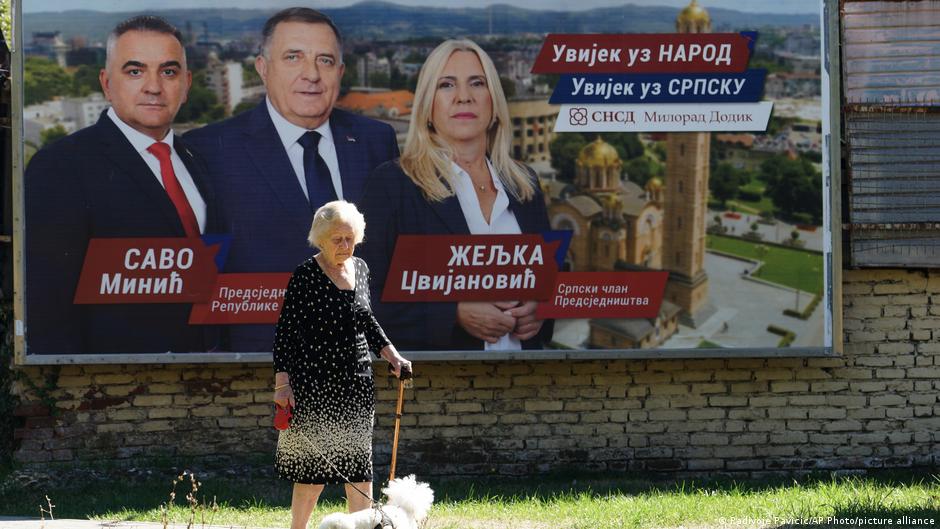
Minic, like Zeljka Cvijanovic, ran for the Alliance of Independent Social Democrats, or SNSD, the party founded by Dodik. Cvijanovic, already a member of the state presidency, was also on course to retain a Serb seat in the presidency after receiving about 55% of the vote, according to the preliminary results.
The preliminary picture was one of continuity: SNSD-backed candidates remained in command of the main Serb political positions, while ruling-party candidates led the wider institutional contests.
Dodik, who is known for close ties with Russia, has already congratulated both Minic and Cvijanovic. His own political future remains constrained by a court decision that bars him from political activity for six years. The ban followed his forced removal from office in 2025 for failing to comply with decisions of Bosnia and Herzegovina’s Constitutional Court and with international agreements.
Dodik has refused to recognize the court decision and traveled to Moscow seeking support. He and Minic met Russian President Vladimir Putin in the Kremlin on September 29, shortly before the vote. That meeting added geopolitical weight to an election whose domestic outcome was widely viewed as predictable.
Presidency Results Signal Limited Change
With 95% of ballots counted, Denis Becirovic remained the leading candidate to represent Bosniak Muslims in the country’s presidency. Becirovic, who had previously served as chairman of the presidency, received about 38% of the vote.
Darijana Filipovic was preliminarily set to represent Croats in the presidency with about 48% of the vote. Cvijanovic was the preferred candidate among Serbs with about 55%.
Bosnia and Herzegovina has a unique presidential system in which the duties of head of state are carried out simultaneously by representatives of Croats, Bosniak Muslims and Serbs, who occupy three seats in the presidency. The arrangement was created under the 1995 Dayton Accords, which were designed to settle disputes among Bosniak Muslims, Orthodox Serbs and Catholic Croats and to end the civil war. Many analysts regard the resulting system as inefficient.
For traders and regional analysts, that inefficiency is part of the investment backdrop. The country’s political structure can slow decision-making, complicate reform efforts and periodically generate headlines that affect perceptions of Balkan risk. The latest vote, however, did not suggest an immediate break from that pattern.
The SNSD also appeared to be winning elections to the Republika Srpska parliament, the National Assembly, according to the Central Election Commission. The same party won the support of a majority of Bosnian Serbs in elections to the lower chamber of the state parliament, the House of Representatives of the Parliamentary Assembly.
That concentration of support gives Dodik’s political network continued leverage even though Dodik himself is formally barred from political office. The practical result is that the party he founded remains central to both entity-level and state-level representation for Bosnian Serbs.
Market Read-Through
The election result is unlikely to generate a sharp standalone move in broader European markets, but it may be read as a stabilizing status quo signal in a country where institutional friction can quickly become a regional concern. Investors focused on frontier Europe will be watching whether the post-election period brings cooperation with state institutions or renewed challenges to constitutional authority.
There were no signs in the preliminary results of a sweeping opposition breakthrough or a shift away from established nationalist and ruling-party blocs. Instead, the vote confirmed the strength of incumbents and Dodik-aligned candidates across the most important contests.
That means the immediate market narrative is one of continuity, not surprise. Political risk remains embedded in Bosnia and Herzegovina’s fragmented governance model, but the election itself has so far delivered the kind of predictable result that markets generally digest without disorderly repricing.