Georgia Opposition Launches New Protest Wave as Political Risk Rises
Thousands marched in Tbilisi as Georgia’s Constitutional Court considers a lawsuit seeking to ban opposition parties.
Georgia’s opposition declared the start of a new wave of protests on Sunday, adding to the political uncertainty surrounding the country as its Constitutional Court considers a lawsuit seeking to ban opposition parties.
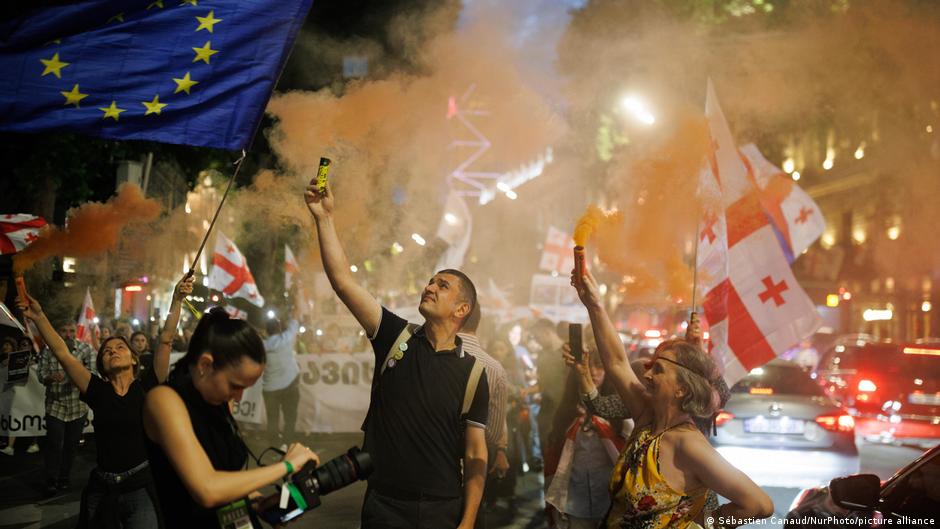
Thousands of demonstrators marched through the capital, Tbilisi, on October 25 under the slogan “Georgia Without Ivanishvili,” a reference to Bidzina Ivanishvili, the influential founder of the governing Georgian Dream party. The demonstration was organized by opposition groups and representatives of civil society.
Participants walked from Tbilisi State University toward Rustaveli Avenue, the central thoroughfare that has repeatedly served as a focal point for political demonstrations. Protesters carried the flags of Georgia, Ukraine and the European Union. A large contingent of security personnel was also present.
The renewed mobilization represents another potential source of headline-driven risk for investors and businesses monitoring Georgia. While the protest reports provided no figures for trading volumes, asset prices or currency movements, an extended confrontation could sharpen attention on political stability, Georgia’s relations with the European Union and the operating environment for companies with exposure to the country.
Opposition Sets November 28 Mobilization
Nika Gvaramia, leader of the Coalition for Change, described Sunday’s march as the beginning of a fresh protest wave. Opposition leaders are seeking a substantially larger turnout on November 28, the second anniversary of the start of mass protests in Georgia.
“We are starting today, and we definitely need a culmination, whether it is on November 28 or in the following days. It is important that there are very many of us on the 28th, so that the wind cannot extinguish the fire,” Gvaramia said before the rally.
Gigi Tsereteli, leader of European Georgia, also attended the march and said a major demonstration was planned for November 28. He argued that the country’s democratic institutions and political system were being dismantled at a time when Georgia had fallen behind in its effort to integrate with Europe.
“What is happening in Georgia today in terms of the destruction of democracy and broader disruption is truly unimaginable, given that we were once a champion on the path toward European integration and today we are outsiders,” Tsereteli said.
He said political parties were being banned and political activity was effectively being restricted. Tsereteli also cited the presence of political prisoners as a significant challenge.
The Constitutional Court’s consideration of the lawsuit places institutional risk at the center of the latest confrontation. Any decision affecting the legal status of opposition parties could become a major catalyst for further street demonstrations and intensify scrutiny of Georgia’s democratic trajectory.
Political Crisis Has Built Since 2024
Mass protests first erupted in Georgia in the spring of 2024 over legislation concerning so-called “foreign agents.” The demonstrations intensified after Georgian Dream won the parliamentary election later that year.
The crisis escalated sharply in November 2024, when the authorities decided to postpone negotiations on Georgia’s accession to the European Union until 2028. That decision transformed the continuing demonstrations into a broader political confrontation over the country’s foreign-policy direction and its prospects for European integration.
Previous protests were accompanied by clashes with police. Law enforcement officers dispersed demonstrators using tear gas and water cannons, raising concerns about the possibility of renewed confrontation if participation grows during the latest campaign.
For markets, the November 28 demonstration is now the next scheduled event to watch. Its size, the authorities’ response and any interim ruling or development in the Constitutional Court case may determine whether the political standoff remains contained or develops into a more disruptive phase.
The situation also carries implications beyond immediate domestic politics. Georgia has long presented its European integration ambitions as a strategic anchor, and opposition leaders are framing the current dispute as a choice over the country’s political system and international alignment. A prolonged crisis could therefore affect perceptions of policy predictability and sovereign risk even in the absence of confirmed immediate moves across local financial markets.