Anti-Government Protests Trigger Violent Clashes in Belgrade Amid Political Unrest
Student-led demonstrations in Serbia’s capital escalate into violent confrontations with police, raising concerns over ongoing political instability.
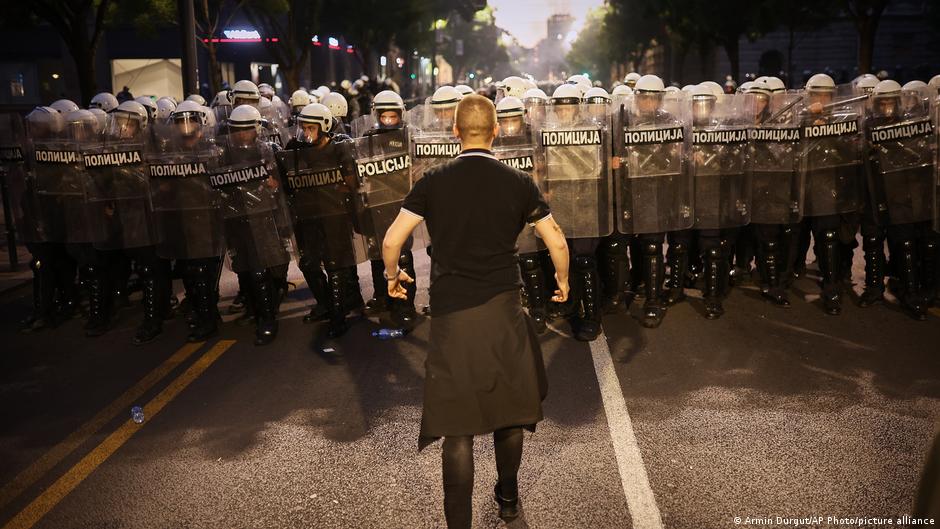
Violent clashes erupted near Pionirski Park in central Belgrade during student protests against the Serbian government, marking a new escalation in the country’s ongoing political unrest. The demonstrations, which began peacefully with tens of thousands of participants, devolved into confrontations involving police use of tear gas and stun grenades.
Escalation of Student-Led Demonstrations
On May 23, large crowds gathered in Serbia’s capital at Slavia Square, where students from various universities initiated a rally. The protest quickly intensified when demonstrators engaged law enforcement officers near the Faculty of Law building close to the Serbian Parliament. Police deployed tear gas and stun grenades in an effort to disperse the crowd.
Authorities reported that protesters attacked police with flares, stones, and improvised explosive devices. The Belgrade prosecutor’s office condemned these attacks as criminal offenses and warned that those responsible would face legal consequences. Interior Minister Ivica Dačić confirmed that 23 individuals were detained in connection with the disturbances.
“All those who assaulted police officers ensuring security after the public assembly at Slavia Square will be identified and held accountable according to the law,” stated the Belgrade prosecutor’s office.
Despite government attempts to restrict mass demonstrations, tens of thousands of people joined the student rally, many carrying placards and wearing T-shirts emblazoned with slogans of the youth movement “Students Prevail.”
Wider Context of Political Turmoil
The protests represent the latest chapter in a series of anti-government demonstrations that began in November 2024 after a deadly collapse of a concrete canopy at the renovated Novi Sad railway station, which resulted in 16 deaths. Protesters attribute the tragedy to corruption, negligence, and cronyism within Serbian leadership and demand the resignation of President Aleksandar Vučić and early parliamentary elections.
Following the unrest, then-Prime Minister and former Novi Sad mayor Miloš Vučević resigned in January 2025. The Serbian parliament confirmed his resignation in March, appointing medical professor Đuro Maćut as the new prime minister. President Vučić emphasized that democratic countries cannot alter election schedules in response to protests.
Subsequent protests in September 2025 also saw violent clashes, with over 40 arrests and injuries to 13 police officers. Demonstrators employed stones, bottles, signal flares, and metal rods against law enforcement, who responded with tear gas and stun grenades.
In December 2025, President Vučić announced that early elections for the National Assembly would take place in 2026, amid ongoing political tensions.
Market Implications
The recurrent social unrest and political uncertainty in Serbia could affect investor confidence and market stability in the region. Disruptions caused by protests—such as transport cancellations and centralized gatherings—may temporarily impact trading volumes and sector rotation, especially in infrastructure and government-linked sectors. Market participants should closely monitor developments as the country approaches its scheduled elections.