Russia to Close Goethe-Institut Branches After Berlin Moves on Russian House
Moscow said it will shut the three Goethe-Institut branches in Russia after Germany moved to terminate an agreement covering the Russian House in Berlin.
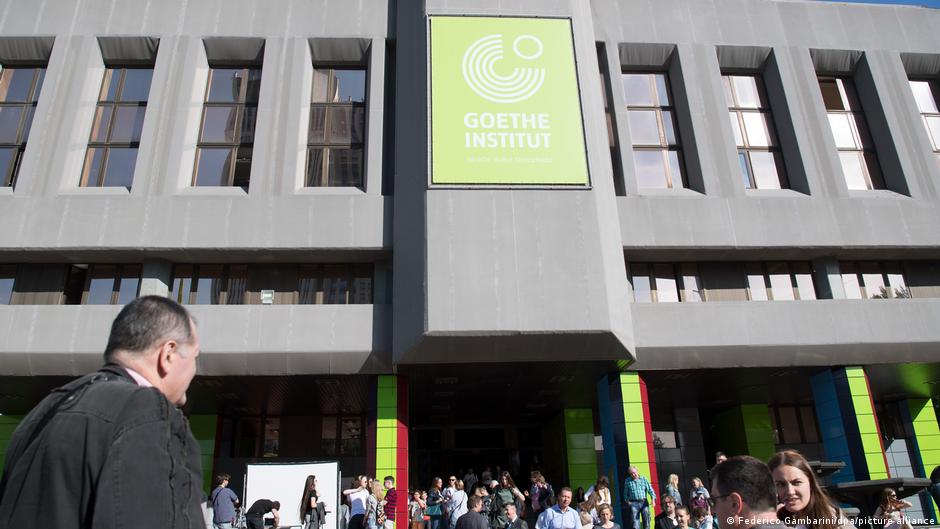
Russia will close all three branches of Germany's Goethe-Institut in the country after Berlin decided to terminate its agreement with Moscow on the operation of the Russian House in Berlin, Russian Foreign Minister Sergei Lavrov said on Thursday, September 3, in a fresh escalation of cultural and diplomatic retaliation between the two countries.
Speaking at the Eastern Economic Forum in Vladivostok, Lavrov said the German cultural institution's offices in Russia would be shut after German authorities moved against Russia's cultural presence in Berlin. The remarks were broadcast on the Russian Foreign Ministry's YouTube channel.
"Of course, they will be closed, after our cultural center was thrown out from there. Otherwise we will not respect ourselves," Lavrov said.
Lavrov said Germany had branches of the Goethe-Institut in Moscow, St. Petersburg and Yekaterinburg. However, according to the institute's own information cited in the source article, its third branch in Russia is located not in Yekaterinburg but in Novosibirsk.
The Russian minister said German authorities had "deliberately" taken a step that, in his words, clearly meant the end of Germany's cultural presence in the Russian Federation, which had remained in place despite what he described as the "Ukrainian vicissitudes" in Russia's relations with the West.
Deutsche Welle said it had asked the Goethe-Institut leadership for comment.
Sanctions backdrop sharpens bilateral tension
Lavrov's statement came a day after German authorities announced tougher sanctions against Russia and blamed Moscow for a drone incident at Leipzig airport in August. According to the source article, Berlin reached that conclusion after examining the drones' settings and certain components that had also been used in other hybrid incidents.
German Interior Minister Alexander Dobrindt was cited as saying that the decision followed analysis of the unmanned aerial vehicles and components linked to other hybrid episodes. The sanctions step added a new security dimension to an already strained relationship, with Germany coupling punitive measures with actions targeting Russian state-linked infrastructure and operations inside the country.
As part of those retaliatory steps, the German government ordered the closure by September 18 of the last remaining Russian consulate general in Germany, located in Bonn. German Foreign Minister Johann Wadephul also said Berlin would terminate the agreement governing the activities of the Russian House in Berlin.
That same agreement also regulated the work of the Goethe-Institut in Russia, making it a central legal mechanism for the two countries' reciprocal cultural operations. By moving to cancel it, Berlin effectively opened the door to the shutdown of the German institute's Russia network, a step Lavrov now says Moscow will carry out.
Germany will also tighten controls on the entry of Russian citizens into the country and strengthen measures against Russia's so-called shadow fleet, according to Wadephul as cited in the source text.
For markets, the latest exchange underscores that sanctions policy and state countermeasures remain an active driver of headline risk in Europe. While Thursday's announcement was focused on diplomatic and cultural institutions rather than direct trade restrictions, it lands alongside Germany's broader tightening package and follows a security-related accusation tied to the Leipzig airport drone incident.
The episode is also notable for investors tracking the expansion of European enforcement measures beyond traditional financial and export controls. Germany's announced steps span consular access, cultural agreements, border controls and actions against the shadow fleet, pointing to a broader use of administrative and regulatory tools in response to alleged hybrid activity.
At the same time, the dispute reflects how bilateral agreements that once sat outside the main sanctions debate can become vulnerable as relations deteriorate further. The Goethe-Institut decision, as described by Lavrov, is framed by Moscow as a reciprocal move after what it views as the expulsion of its cultural center from Berlin.
The Goethe-Institut has long served as Germany's flagship cultural network abroad. The pending closure of its Russia branches would mark another contraction in institutional ties between Moscow and Berlin, coming after multiple rounds of sanctions, diplomatic expulsions and restrictions since Russia's full-scale war against Ukraine reshaped European relations with the Kremlin.
No timeline beyond Lavrov's announcement was provided in the source article for when the closures in Russia would take effect. Germany's deadline for the closure of the Russian consulate in Bonn, however, was set for September 18.
Thursday's comments place cultural diplomacy squarely inside the wider sanctions confrontation. For businesses, policymakers and market participants monitoring Europe-Russia exposure, the practical message is that the scope of retaliatory action remains fluid and can extend quickly from security allegations into institutional and cross-border operating arrangements.
Whether the Goethe-Institut closures trigger further reciprocal steps was not addressed in Lavrov's remarks as reported. But the sequence of moves this week shows that developments tied to sanctions enforcement and hybrid incident allegations are continuing to produce fast-moving consequences across multiple sectors of the Germany-Russia relationship.