North Korea Missile Launch Raises Market Watch Over Korean Peninsula Risk
South Korea said North Korea fired at least one ballistic missile toward the Sea of Japan after a border blast deepened security tensions.
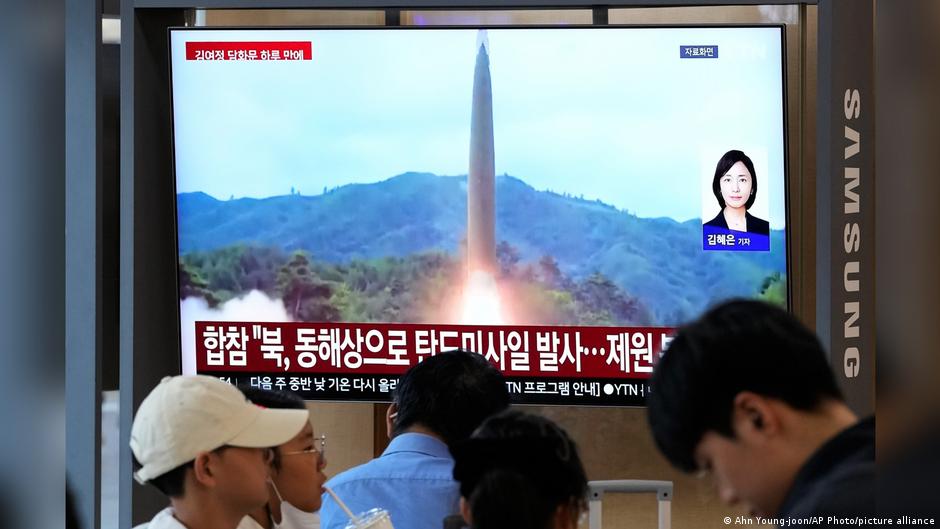
North Korea fired at least one ballistic missile toward the Sea of Japan, South Korea’s military said on Saturday, October 3, adding a fresh geopolitical risk signal for investors tracking security developments on the Korean Peninsula and across Northeast Asia.
The launch was reported by South Korea’s Joint Chiefs of Staff, which said Seoul, Washington and Tokyo were maintaining a high level of readiness while closely sharing information on North Korean ballistic missiles. The statement did not provide market-related data, details on the missile’s flight path, or confirmation of whether the projectile landed inside or outside any exclusive economic zone.
“South Korea, the United States and Japan are maintaining a high level of combat readiness, while maintaining close information sharing on North Korean ballistic missiles,” Seoul said.
For markets, the immediate significance lies less in confirmed economic disruption than in the timing and regional risk backdrop. Missile launches by North Korea are closely watched by currency, equity, defense, shipping and energy market participants because they can alter risk appetite around South Korean and Japanese assets, even when direct commercial impact is limited. The latest report comes after Seoul accused Pyongyang of violating the Korean War armistice following a blast in a border area last month.
Security Headlines Add To Regional Risk Monitoring
The missile launch followed a September 21 explosion in the border zone between North and South Korea that injured three South Korean service members. Seoul believes the incident resulted from the detonation of North Korean anti-personnel mines, AFP reported, citing South Korean military sources.
South Korean Defense Minister Kang Shin-chul accused Pyongyang of violating the armistice and said Seoul intended to take retaliatory measures. South Korea’s Joint Chiefs of Staff demanded that North Korea issue an apology.
North Korea rejected the accusation. Kim Yo Jong, the sister of North Korean leader Kim Jong Un, described the South Korean assertion as “extremely low and dirty,” according to North Korea’s state news agency KCNA.
The exchange adds to a familiar but important pattern for real-time market intelligence: military developments on the peninsula can become trading catalysts when they coincide with fragile sentiment, active regional sessions, or existing pressure on Asian risk assets. The source report did not cite market moves, trading volumes, sector rotation, or asset-price reactions tied to the launch. As a result, the event should be read as a breaking geopolitical development rather than evidence of a confirmed market dislocation.
Still, the Korean Peninsula remains a standing risk factor for investors because of South Korea’s role in global technology supply chains, Japan’s position as a major financial market and safe-haven funding currency, and the importance of Northeast Asian sea lanes. Missile activity can prompt traders to reassess exposure to regional equities, the South Korean won, the Japanese yen, defense-linked shares and broader Asia-Pacific risk sentiment.
Armistice Tensions Remain Unresolved
The broader context is the unresolved legal status of the Korean conflict. South Korea and North Korea technically remain at war: the Korean War ended in 1953 with an armistice agreement, not a formal peace treaty. The two countries are separated by the demilitarized zone, with a military demarcation line running through the middle of the mined strip.
That border remains one of the most heavily fortified and mined frontiers in the world. The September blast and the subsequent missile launch therefore feed into an already high-sensitivity security environment, where statements from military authorities can quickly become relevant for investors monitoring potential escalation.
South Korea’s statement emphasized coordination with the United States and Japan. That trilateral channel is central to how regional governments monitor North Korean missile activity and manage deterrence. For markets, coordinated security messaging can matter because it signals whether the event is being treated as an isolated launch or as part of a wider escalation cycle.
The source report did not state whether North Korea provided advance notice of the launch, identified the missile type, or connected the launch to the earlier mine-blast dispute. It also did not report any response from Japan or the United States beyond the South Korean statement that the three countries were sharing information and maintaining readiness.
In trading terms, the key watch points after such an event would normally include official follow-up from Seoul, Tokyo and Washington; any North Korean statement framing the launch; confirmation of the number and type of missiles; and whether regional financial markets show a sustained move beyond headline-driven volatility. None of those market indicators was included in the source account.
The latest launch nevertheless arrives at a sensitive moment. Seoul’s accusation that Pyongyang violated the armistice, Pyongyang’s rejection of that claim, and South Korea’s stated intention to take responsive measures all increase the importance of subsequent official communications. For market participants, the immediate issue is whether the episode remains contained within military signaling or develops into a more persistent risk premium across Northeast Asian assets.