German Anti-Extremism Protests Draw Large Crowds After AfD Election Win
Demonstrations across more than 35 German cities highlighted political risk for investors tracking election momentum, polling and policy stability.
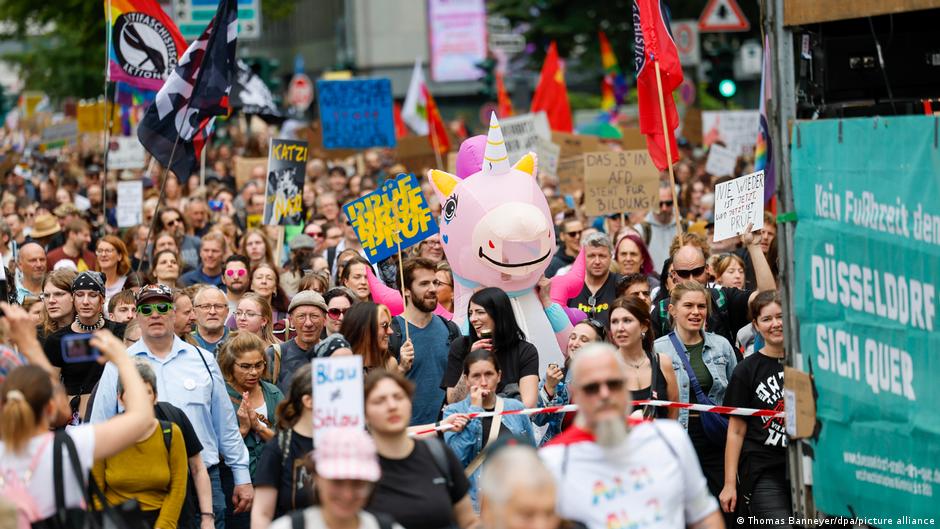
Mass demonstrations against right-wing extremism took place in more than 35 German cities on September 12, bringing tens of thousands of people into the streets one week after the far-right Alternative for Germany, or AfD, won a state election in Saxony-Anhalt. For market participants, the protests add another real-time signal to Germany’s shifting political risk landscape, where electoral momentum, coalition constraints and institutional responses are increasingly relevant to expectations around policy continuity.
Organizers estimated that 25,000 people joined the rally in Hamburg, while around 20,000 took part in Düsseldorf and 18,000 demonstrated in Berlin, according to police estimates cited for the capital. The Düsseldorf turnout figure was also confirmed by local police. In Munich, public broadcaster ARD estimated participation at 12,000. Around 2,000 people demonstrated in Mainz.
The protests were organized by more than 100 associations and followed AfD’s victory in Saxony-Anhalt, a result that has sharpened attention on the party’s regional strength and the broader debate over whether German institutions should move toward a ban procedure. Although the demonstrations were civic rather than financial events, they unfolded against a backdrop of heightened scrutiny of German political stability, a factor closely watched by investors in European equities, sovereign debt and the euro area’s largest economy.
Political Risk Signal After Saxony-Anhalt Vote
Participation varied by city, but the geographic spread was broad. In Magdeburg, the capital of Saxony-Anhalt, about 1,100 people joined the demonstration. In Saarbrücken, 1,500 people took part. Several hundred participated in Erfurt. In Schwerin, the capital of Mecklenburg-Western Pomerania, where AfD is also leading in polls one week before local elections, several dozen people joined a rally.
That distribution matters for readers focused on market intelligence because it shows the political reaction is not limited to Germany’s largest urban centers. The demonstrations reached both national commercial hubs and regional capitals that are directly exposed to upcoming electoral tests. In market terms, the key issue is not trading volume on the day of the protests but the information flow they create around voter polarization, institutional response and potential policy fragmentation.
Several demonstrations, including those in Munich, Mainz, Saarbrücken and Magdeburg, were held as part of the Prüf campaign. The campaign calls for closer examination of parties classified by Germany’s Federal Office for the Protection of the Constitution, known as BfV, as either suspected of right-wing extremism or definitely right-wing extremist. The campaign name translates from German as “check,” and organizers present it as an acronym for Prüfung Rettet Übrigens Freiheit, meaning “Examination, by the way, saves freedom.”
Prüfung Rettet Übrigens Freiheit — “Examination, by the way, saves freedom.”
The rallies included demands to launch a procedure to ban AfD. In May 2025, BfV classified the party as right-wing extremist at the federal level. That classification, however, is not currently in effect because of a lawsuit filed by the party. The legal status of that classification remains central to the next phase of the debate, especially for observers assessing whether Germany’s institutional checks could move from political pressure into formal legal action.
In Düsseldorf, demonstrations took place under the slogan “No step back! Against AfD and right-wing incitement” — in German, “Kein Schritt zurück! Gegen die AfD und rechte Hetze!” In Hamburg, the slogan was “Time to act — freedom must be defended,” or “Zeit zum Handeln - Freiheit muss verteidigt werden.”
Polling Adds To Uncertain Policy Backdrop
Polling data show a divided electorate on the question of banning AfD. A survey by the INSA opinion research institute conducted on September 10 and 11 found that 42% of respondents supported the idea of banning AfD, while 45% opposed it. The figures point to a narrow but meaningful split that could shape political positioning across Germany’s party system.
The same poll also showed that almost half of Germans, 46%, opposed the “firewall” policy toward AfD, which refers to refusing cooperation with the party. Thirty-four percent supported maintaining the barrier, while 20% were undecided. For markets, that divide is relevant because the firewall has been a central assumption in coalition arithmetic and mainstream party strategy. Any shift in the perceived durability of that barrier could affect expectations for state-level governance and, over time, federal political dynamics.
German assets did not feature directly in the protest reports, and the source material did not cite market prices, volumes or immediate trading reactions. Still, the demonstrations represent a live political event in Europe’s largest economy, with implications for investors who track election risk, regulatory stability and sector exposure to public policy. In particular, German industrials, utilities, defense, infrastructure and public-sector-linked businesses remain sensitive to fiscal direction, coalition durability and regional policy execution.
The demonstrations also arrive as European markets continue to monitor the interaction between domestic politics and broader macro conditions. Germany’s political calendar, regional polling and legal debate around AfD now form part of a wider risk dashboard alongside growth, inflation, rates and corporate earnings. The protests on September 12 did not settle the debate, but they underscored that political mobilization against the far right remains substantial and geographically dispersed.
For traders and portfolio managers, the immediate readout is that Germany’s political risk premium is being shaped by two competing signals: AfD’s electoral and polling strength on one side, and large-scale civic mobilization and institutional scrutiny on the other. The balance between those forces will remain important as investors assess whether current political tensions stay contained within regional politics or begin to influence national policy expectations more directly.