Armenia’s Ruling Civil Contract Party Leads Parliamentary Elections Amid Geopolitical Tensions
With over 55% of ballots counted, Prime Minister Pashinyan’s party secures majority vote amid opposition claims and Moscow’s discontent.
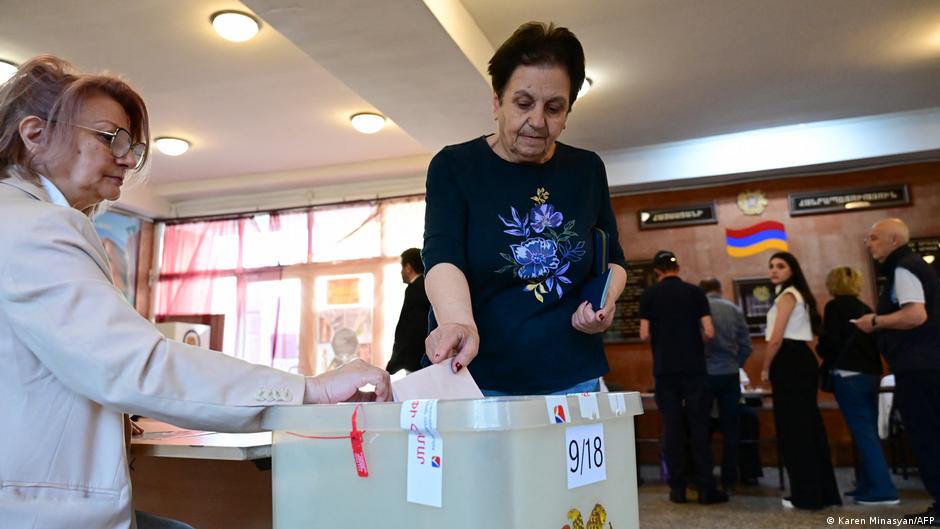
On June 7, Armenia held pivotal parliamentary elections expected to shape the country’s foreign policy trajectory for years ahead. Early results from the Central Electoral Commission (CEC), after processing 55.95% of votes, show the ruling Civil Contract party led by Prime Minister Nikol Pashinyan in the lead with 50.86% of votes.
The opposition alliance Strong Armenia, headed by Russian-Armenian businessman Samvel Karapetyan, captured 23.19% of votes, while another opposition bloc, Armenia, led by former president Robert Kocharyan, secured 9.6%. The Prosperous Armenia party, led by businessman Gagik Tsarukyan, crossed the 4% threshold with 4.1%, and the Wings of Unity party of former ombudsman Arman Tatoyan received 2.3%. Voter turnout reached 58.97%, exceeding levels seen in 2018 and 2021.
Election Outcomes and Political Implications
Armenia’s National Assembly comprises 105 deputies, including four seats reserved for national minorities: Yazidis, Russians, Kurds, and Assyrians. Prime Minister Pashinyan declared victory for his party while less than 20% of ballots had been counted, stating that Civil Contract would form a government independently. This early claim sparked criticism from opposition leaders.
Opposition blocs have denounced Pashinyan's statement as a step toward power usurpation and an unconstitutional overreach interfering with the electoral commission’s authority.
The Armenia bloc accused the prime minister of undermining democratic processes, calling his remarks a "gross interference" with the CEC. Arman Tatoyan of Wings of Unity labeled the announcement unconstitutional and outside the remit of government powers.
The elections featured 18 political parties contesting under a proportional representation system. No minimum turnout threshold is legally required. Approximately 2.5 million Armenians held voting rights, with no polling stations abroad; however, electronic voting was arranged for diplomats stationed overseas.
Electoral thresholds were set at 4% for single parties, 8% for three-party alliances, and 10% for alliances of four or more parties. The electoral code mandates the formation of a stable parliamentary majority with at least 54% of seats. Should this not occur through initial results or coalition formation, a runoff election will be held.
Geopolitical Context and Market Impacts
In 2025, Pashinyan legally committed Armenia to closer integration with the European Union, positioning the country on a path potentially at odds with Moscow’s interests. The prime minister insists this is not a move to sever ties with Russia. Conversely, opposition parties favor maintaining strong relations with Russia.
Moscow has expressed dissatisfaction with Armenia’s EU rapprochement. Russian President Vladimir Putin likened the situation in Armenia to the conditions preceding the crisis in Ukraine. Ahead of the elections, Russia imposed import bans and restrictions on Armenian products including alcohol, agricultural goods, flowers, and fish.
These developments could influence regional trade flows and investment sentiment in Armenia, particularly as EU integration efforts progress alongside Moscow’s trade restrictions. Market participants should monitor parliamentary outcomes and resulting policy decisions closely for potential impacts on sector rotation, trade volumes, and investor confidence in the South Caucasus region.